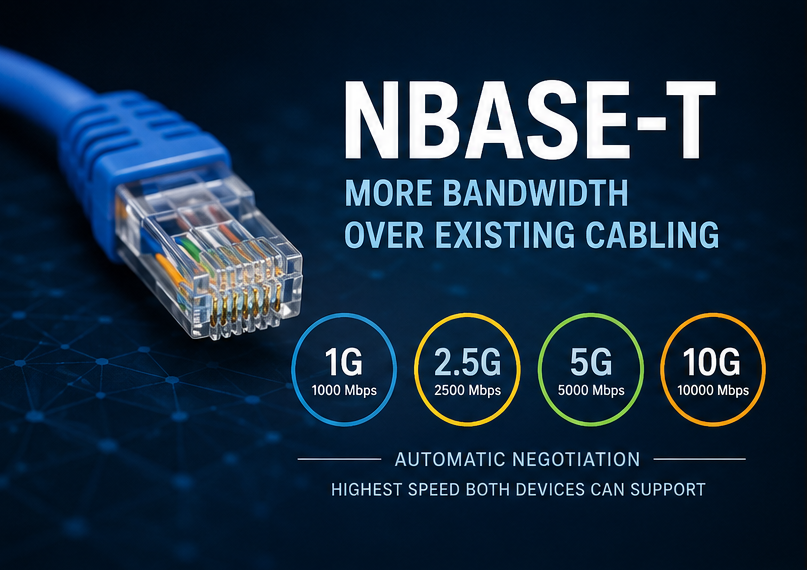
NBASE-T fills the gap between traditional Gigabit Ethernet and 10 Gigabit Ethernet. Instead of forcing every copper link to jump from 1 Gbps straight to 10 Gbps, it adds intermediate speeds of 2.5 Gbps and 5 Gbps. The switch and the connected device negotiate the fastest speed that both the hardware and the cabling can support. Negotiation is just a signal-to-noise problem. It’s easier to maintain a 2.5 Gps or 5 Gbps link than it is a 10 Gbps link because of this.
Why NBASE-T Exists
Category 5e cable is everywhere. Schools, office buildings, hospitals, and hotels have thousands of cable runs that were installed years before Wi-Fi access points started pushing several gigabits of aggregate traffic. Replacing all of that cabling is pretty labor-intensive, which means it’s quite expensive.
A Wi-Fi 6 or Wi-Fi 7 access point can deliver more than 1 Gbps of aggregate traffic. Once the Ethernet uplink reaches line rate, packets begin waiting for transmission even though the wireless radios still have capacity available. Moving that uplink to 2.5 Gbps or 5 Gbps gives the access point more capacity.
Supported Speeds
Most NBASE-T devices support these link speeds:
- 1 Gbps
- 2.5 Gbps
- 5 Gbps
During auto-negotiation, both ends select the highest stable speed the cable can reliably support. A cable that will not maintain a clean 10 Gbps link may operate perfectly at 5 Gbps.
It Uses the Same RJ-45 Connector
NBASE-T does not require a different connector or patch panel. It uses the same RJ-45 ports already found on anything remotely modern. The physical layer uses more efficient signaling to carry additional data across the existing copper pairs.
From the switch, the port behaves like any other Ethernet interface. The interface comes up, negotiates a speed, and forwards frames normally. Unless you look at the interface details, you may never notice the link is running at 2.5 Gbps instead of 1 Gbps.
Most Common use cases
Wireless access points are the most common reason to deploy NBASE-T. One access point serving dozens of users can push enough traffic to keep a 1 Gbps uplink busy for long periods. Increasing the uplink to 2.5 Gbps often removes the bottleneck while leaving the existing cabling in place.
Security cameras also benefit from multi-gigabit Ethernet. High-resolution video streams from many cameras can quickly consume available bandwidth on a switch. More capacity between the switch and the aggregation layer provides additional capacity for video streams.
Cabling quality definitely matters
The quality of the cable installation ultimately still determines the link’s maximum speed. Poor terminations, damaged cable, or excessive interference can prevent a link from negotiating at the best rate. Category 5e cable can support 2.5 Gbps and 5 Gbps over standard Ethernet distances when installed correctly. Category 6 and Category 6A provide additional margin. Again, when installed correctly.
Final Thoughts
NBASE-T gives network operators another option above gigabit speeds. It lets many existing Category 5e installations carry more traffic without replacing the structured cabling.
j2networks family of siteshttps://j2sw.com
https://startawisp.info
https://indycolo.net
#packetsdownrange #routethelight
Discover more from Justin Wilson (j2sw)
Subscribe to get the latest posts sent to your email.