
In this article
In modern networks, convergence speed is everything. Whether you’re running OSPF, BGP, or static routes with failover, the faster your network can detect a failure and reroute traffic, the better the user experience. This is where BFD—Bidirectional Forwarding Detection—comes into play.
What is BFD?
BFD is a protocol designed to rapidly detect link or path failures between two forwarding engines. It operates independently of routing protocols but works in conjunction with them to improve failure detection and response times.
While traditional routing protocols rely on hello/dead timers (like 30/120 seconds in OSPF), BFD can detect failures in milliseconds—sometimes as fast as 50ms or less. That means faster failover, fewer dropped packets, and less downtime.
- RFC 5880 Bidirectional Forwarding Detection (BFD)
- RFC 5881 BFD for IPv4 and IPv6 (Single Hop)
- RFC 5882 Generic Application of BFD (Single Hop)
Why BFD for your Network
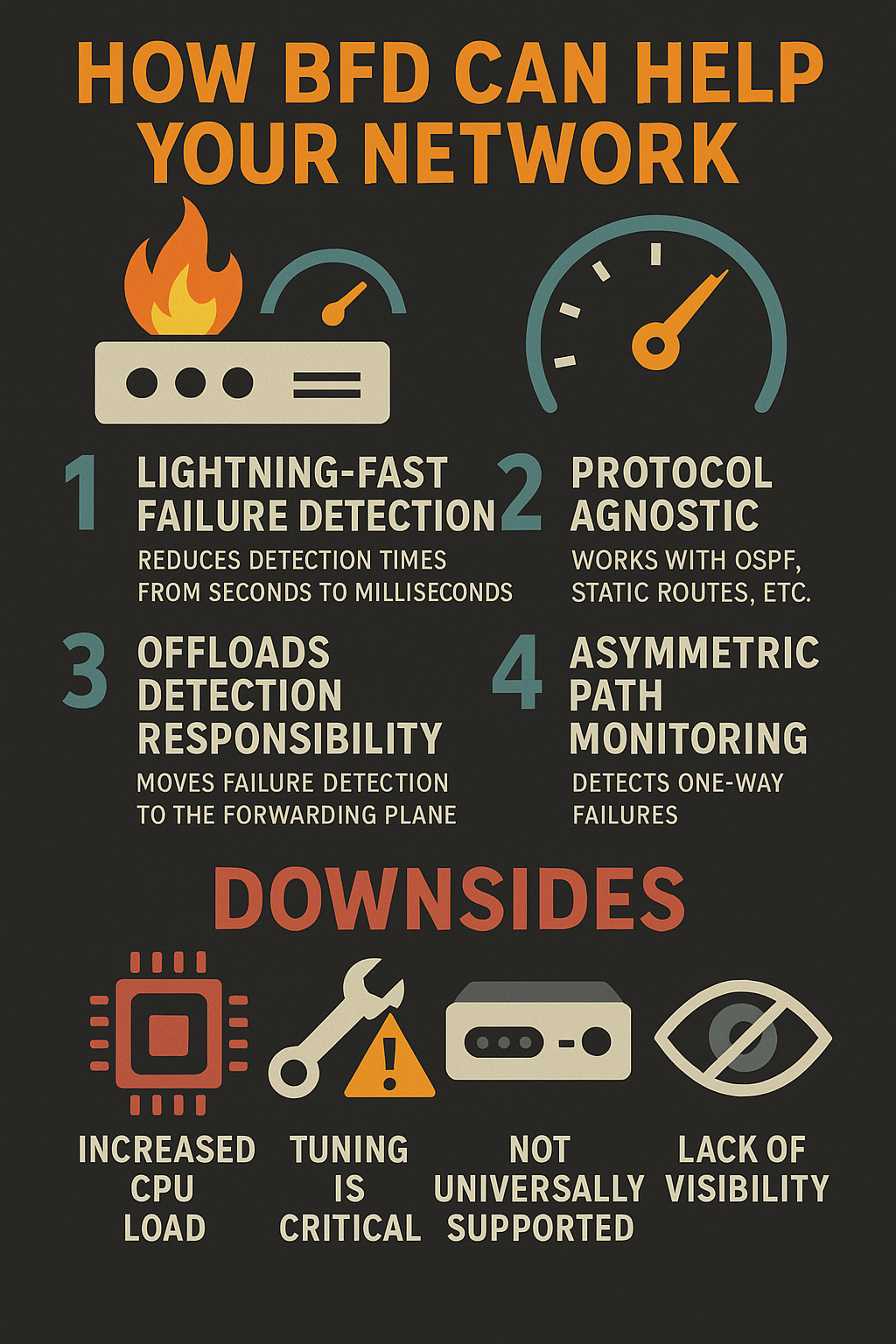
1.Fast Failure Detection
Routing protocols aren’t optimized for sub-second failure detection. With BFD, you can drop your detection times from tens of seconds to just tens of milliseconds. For real-time applications like VoIP, video conferencing, and gaming, this can mean the difference between a hiccup and a hang-up.
2. Protocol Agnostic
BFD can be used alongside OSPF, BGP, IS-IS, and even static routes. That makes it versatile and powerful, improving convergence across the board without being tied to any one protocol.
3. Offloads Detection Responsibility
BFD shifts failure detection from the control plane to the forwarding plane, reducing load on the CPU. It’s like having a dedicated watchdog focused solely on making sure packets can still flow.
4. Asymmetric Path Monitoring
With BFD, each direction of a connection is monitored independently. That means it can detect one-way failures—something that most link protocols can’t do. Ever had an OSPF adjacency not go to full due to a strand failure on a pair? BFD can detect this quicker than OSPF can.
Where BFD Can Bite You: Downsides to Consider
While BFD is powerful, it’s not magic—and it comes with some caveats:
1. Increased CPU Load (on lower-end gear)
BFD packets are frequent and fast. On lower-end routers or switches, this can strain the CPU, especially if you’re running aggressive timers across many peers. The faster the timers, the more processing overhead.
⚠️ For example, running BFD with 50ms intervals and a 3-miss detection multiplier across dozens of BGP sessions can swamp older or underpowered gear.
2. Tuning is Critical
Misconfigured BFD timers can lead to false positives—declaring a link down when it isn’t. This can cause unnecessary route flapping, instability, or blackholing of traffic. Proper tuning is critical and often requires some trial and error. This can be compounded by trying to tweak BFD on wireless, microwave, and other transport mediums.
3. Not Universally Supported
Not all platforms (especially older ones) support BFD. And among those that do, implementation quality varies. Some vendors may have incomplete or buggy BFD features, particularly on third-party transceivers or non-native interfaces. BFD can also change behavior if a software release introduces bugs to the BFD protocol.
4. Lack of Visibility
Unlike routing protocols that often log neighbor state changes, BFD can operate quietly, sometimes too quietly. Without proper logging and monitoring, you may not realize BFD is misfiring or failing silently. Even then, you have to normally monitor for BFD log changes.
Use Cases Where BFD Really Helps
- High-availability networks with sub-second SLA requirements
- BGP peerings over physical or logical links where failure detection needs to be fast
- Redundant paths between data centers or critical POPs
- Microwave or wireless backhaul, where physical links may not go “down” but performance degrades or drops
BFD is like the smoke detector of your network—fast, lightweight, and potentially life-saving. But just like a smoke detector, it needs to be installed correctly, maintained, and not oversensitized to the point of annoyance or harm.
Use it wisely, test your configs, and monitor its behavior. When implemented right, BFD can dramatically reduce downtime, boost convergence times, and keep your users blissfully unaware that anything ever went wrong.
j2networks family of siteshttps://j2sw.com
https://startawisp.info
https://indycolo.net
#packetsdownrange #routethelight
Discover more from Justin Wilson (j2sw)
Subscribe to get the latest posts sent to your email.