
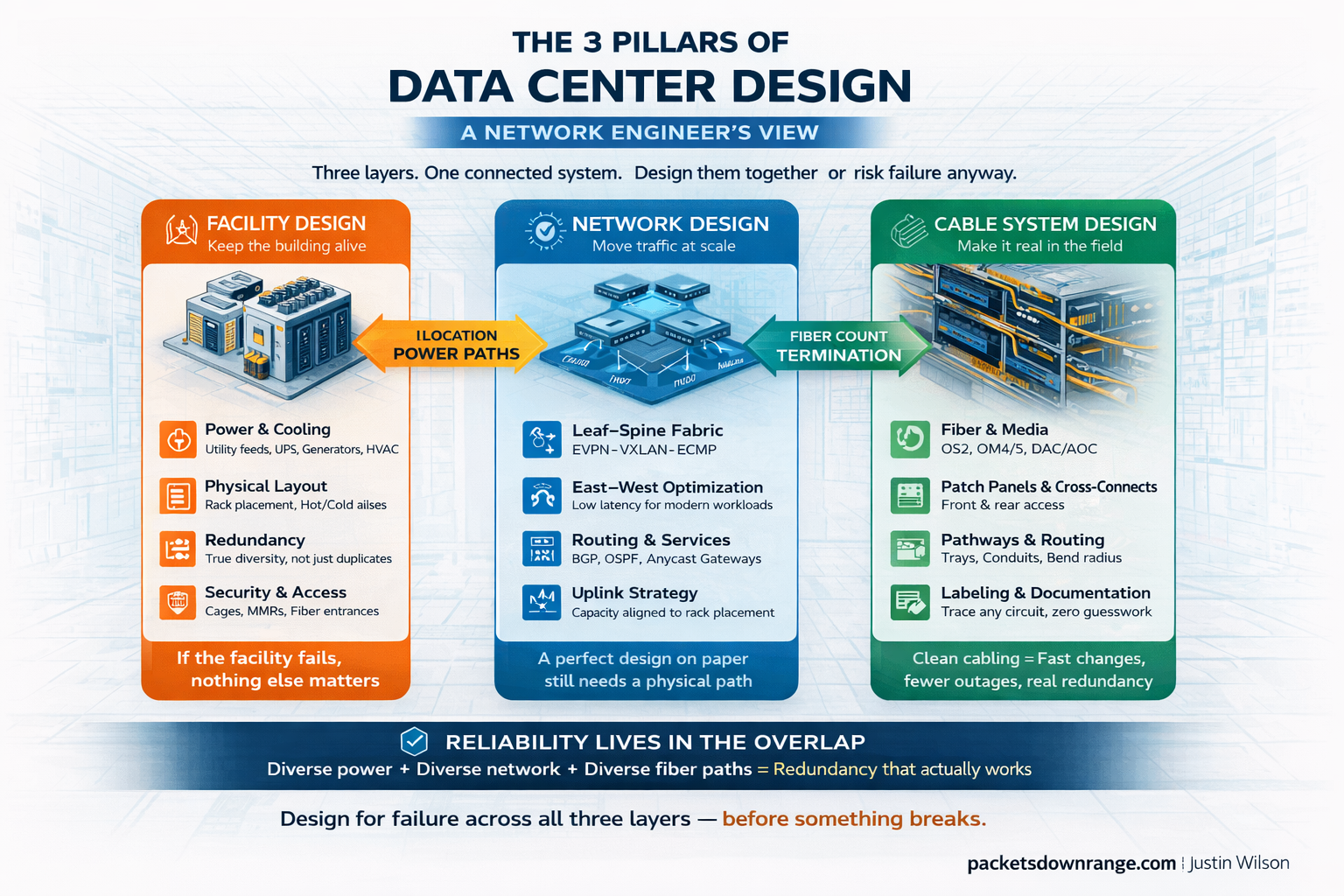
Many people view a data center as simply rows of racks and blinking lights or a large building. However, power, cooling, network paths, and physical layout must align. When they do not, outages can occur that only make sense when traced back to decisions made months or years earlier. For network engineers, data center design goes beyond switches and routers. The goal is to create an environment where failures are predictable and repeatable, not just to ensure basic functionality.
There are three major layers that shape every data center. They work together whether.
- Facility design
- Network design
- Cable system design
Facility Design
Facility design is everything that keeps the building running. Power feeds, UPS systems, generators, cooling, airflow, rack layout, and physical security all live here. This is where non-technical folks tend to focus, because it is tangible and expensive.
From a network perspective, facility design has subtle impacts. Consider whether meet-me-rooms (MMRs) are available, the distance between cages and fiber entrances, and whether power feeds are diverse at the rack level. Assess if airflow supports high-density compute, as inadequate airflow can cause thermal issues when deploying GPU clusters. Dual power feeds offer little benefit if they share the same conduit or terminate in the same room, a fact often discovered during problematic maintenance windows.
Network Design
Network design is the part most engineers feel comfortable with. Routing protocols, switching fabrics, overlays like EVPN, and traffic engineering are all in this category. This is where you define how traffic moves and how failure is handled at Layer 2 and Layer 3.
Modern data centers often use leaf-spine architectures. East-west traffic is predominant, particularly with storage replication and AI workloads. As a result, capacity planning focuses less on ingress and egress and more on efficiently moving traffic across the fabric to avoid hotspots.
The challenge is designing a clean topology that ignores physical challenges. You can build a perfect fabric on paper and still end up with uneven latency or congestion due to where the racks sit, how cables are routed, or how uplinks are distributed. The network does not exist in isolation, even if the diagram looks neat.
Cable System Design
Cable system design is the nitty-gritty of data center buildings. Fiber types, patch panels, cross-connects, labeling, and physical paths all go into a good system. This is the layer that determines how fast you can deploy, troubleshoot, and scale.
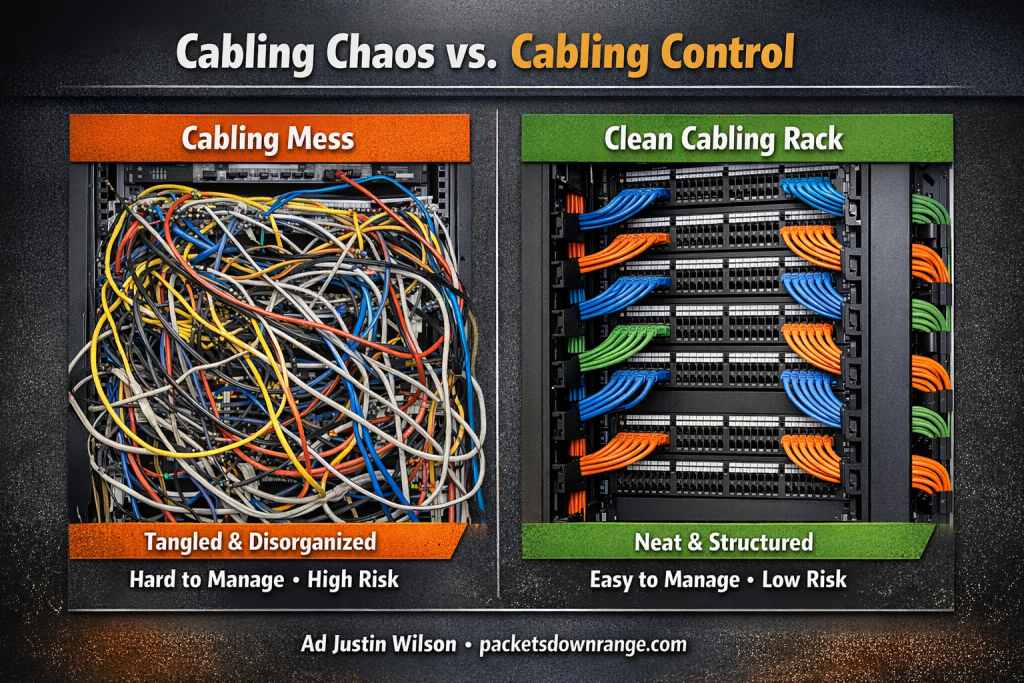
A well-designed cable system simplifies changes and additions. It allows for quick identification of circuit endpoints, capacity expansion without guesswork, and reduced human error during maintenance. In contrast, a poorly designed system complicates every change, increasing risk and inefficiency.
Engineers often inherit cable plants that have evolved over time. Varying standards, inconsistent labeling, and undocumented paths can make it safest to avoid changes, which slows operations. Eventually, remediation becomes more cost-effective than maintaining the status quo.
Where It All Comes Together
Facility decisions influence network equipment placement. Network design dictates fiber quantity and termination points. Cable system design ensures that logical redundancy is realized in practice.
A simple example is diverse paths. Diverse paths may appear redundant on a diagram, but in practice, both links might share the same tray, conduit, or patch panel. If a failure occurs, both paths can be affected. True redundancy requires more than simply having two cables, the lessons learned are simple. The reliability of a data center is not defined by any single component. It is defined by how well these different layers are coordinated.
For engineers, the principle is equally clear: design for failure across all three layers, not just your own. Focusing solely on the network will eventually lead to issues with the facility or cabling.
j2networks family of siteshttps://j2sw.com
https://startawisp.info
https://indycolo.net
#packetsdownrange #routethelight
Discover more from Justin Wilson (j2sw)
Subscribe to get the latest posts sent to your email.