
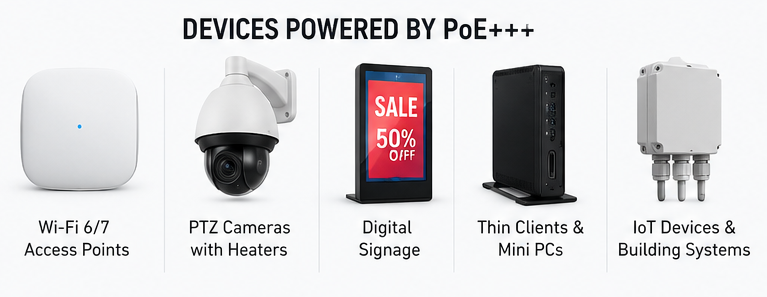
Power over Ethernet has been around for a while, but PoE+++ really changes what you can run off a single Ethernet cable. The older standards were fine for phones, cameras, and small APs. With PoE+++, you can power gear that used to need its own outlet or a power brick. Now, in many installs, that one Ethernet run handles both data and enough juice for big Wi-Fi radios, PTZ cameras, digital signage, and even thin clients.
The ‘+++’ label gets thrown around a lot, but most folks mean IEEE 802.3bt Type 3 or Type 4 when they say it. Plus, +++ is a pain to say (see what I did there?)The first PoE standard, 802.3af, topped out at 15.4 watts. PoE+ (802.3at) bumped that up to 30 watts. When you hear PoE++ or PoE+++, think 60 or 90 watts, using all four pairs in the cable.
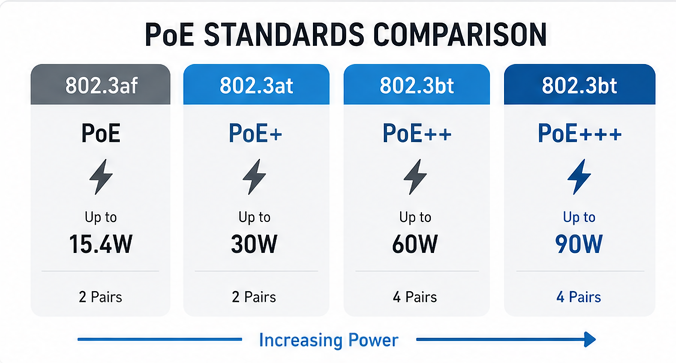
One of the big changes with PoE+++ is how the switch uses the cable pairs. The older standards usually only powered devices over two pairs. 802.3bt uses all four at once. That spreads out the current, reduces resistance, and lets you push more power over an Ethernet cable. It also changes how heat builds up in big cable bundles.
Cable quality becomes much more important as you push higher-wattage PoE. Cheap patch cables with thin conductors can cause voltage drops under load. You might see a device boot up, then crash as soon as the radios kick in or a heater turns on. Outdoor APs and PTZ cameras are good at showing this problem, since their power draw can spike during normal use.
PoE+++ also changes how switches are built. High-density PoE switches now need bigger power supplies and better cooling. A 48-port switch at 90 watts per port is over 4,000 watts, not even counting what the switch itself uses. Most switches can’t actually run every port at full power unless they’re built for it.
This is why engineers have to look at PoE budgets, not just how many ports are on the switch. You might have a 48-port PoE+++ switch, but only enough power for 24 high-draw devices. The rest need to be lower-power gear. Vendors usually show this as a total wattage rating, like 740W or 1440W.
Wireless networking is a big reason PoE+++ is taking off. Wi-Fi 6 and 7 APs have more radios, bigger CPUs, and higher transmit power. Some of these APs pull over 30 watts when they’re running full tilt. Without the higher PoE standards, the AP might boot up in low-power mode and shut off radios or USB ports.
Security systems are another thing driving more power. The old fixed cameras didn’t use much power. Now, PTZ cameras with heaters and IR systems can draw much more power. In winter, power draw can jump as soon as the heaters turn on.
Digital signage and smart building systems are also increasingly adopting PoE+++ because it makes installations easier. Running a single Ethernet cable is cheaper than pulling both network and electrical. This is a big win in places like stores, schools, or warehouses where you might need to move displays or sensors later. Moves and changes just mean running a new cable, not calling an electrician.
Heat is a real issue in dense PoE+++ setups. More current in the copper means more heat inside the cable. Big bundles in trays with limited airflow can exceed their temperature ratings and cause greater signal loss. That’s one reason many installations are moving to Cat 6A for these types of runs.
Voltage drop testing is more important than just checking continuity in these types of setups. A tester might say all pairs are good, but the device still fails when it’s actually drawing power. This is why cheap cabling can be a major issue.. Access switches are now simultaneously powering cameras, phones, and other systems. During a power outage, the UPS runtime calculation must include endpoint load, not just switch consumption. A closet that once lasted an hour on battery may now drain in minutes once hundreds of watts of endpoint power are added.
j2networks family of siteshttps://j2sw.com
https://startawisp.info
https://indycolo.net
#packetsdownrange #routethelight
Discover more from Justin Wilson (j2sw)
Subscribe to get the latest posts sent to your email.