

Welcome to part 1 of the series explaining what an Internet Service Provider (ISP) is. We all use an ISP to connect to the Internet. Some are small, servicing a single town or even a single building. Others have networks in multiple states or even countries. In this series, I will go through the components that make up an Internet Service Provider and outline how they work together.
An ISP is the network responsible for moving traffic between customers and the rest of the Internet. The ISP assigns IP addresses, advertises routes, transports packets through physical infrastructure, and exchanges traffic with other networks.
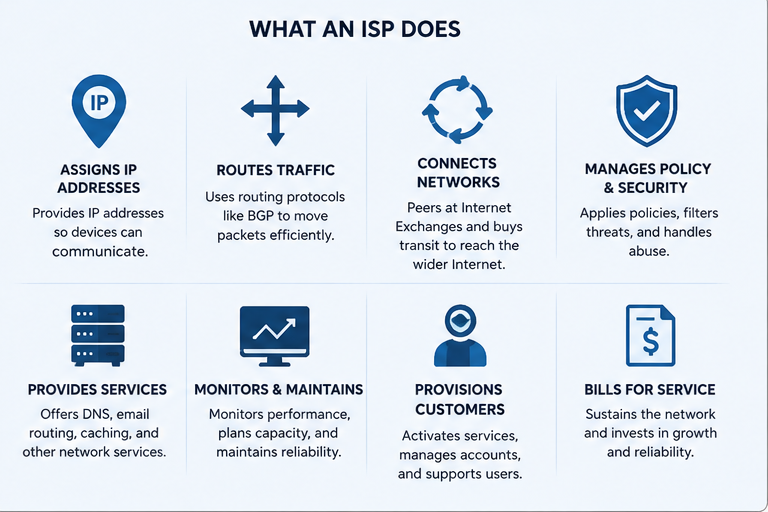
An ISP is the in-ramp between customers and the Capital I Internet. On one side, it connects homes and businesses. On the other side, it connects to carriers, cloud providers, content networks, and Internet Exchanges. Traffic constantly moves between those boundaries. When someone streams a video, opens a website, or joins a game server, packets move through multiple provider networks before reaching the destination.
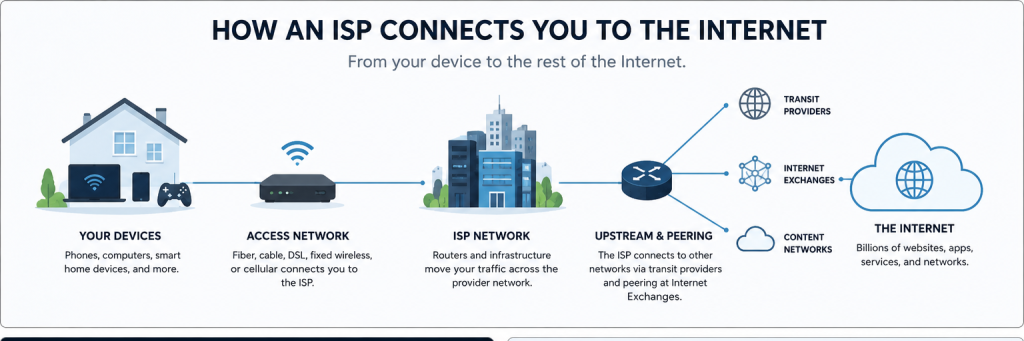
The access network is the part customers usually recognize. This includes technologies such as fiber, cable, DSL, fixed wireless, or cellular connectivity. The access layer gets traffic from the customer location into the provider network. The actual Internet portion begins after the traffic reaches the aggregation routers and the core infrastructure.
From a physical perspective, ISPs are collections of routers, cables, and electronics that work together to deliver the Internet. Routers exchange routing information with external networks using BGP, so they know where the traffic should go. Optical transport systems carry traffic between facilities and markets. DNS resolvers help customers find destinations. Systems assign IP addresses to customer devices. Most users never see the engineering side of an ISP. Many times it’s not a glamorous thing. Unassuming boxes in data centers and wiring. Oh, so much wiring.
The ISP also decides how traffic exits the network. Some traffic goes through paid transit providers. Other traffic moves through peering connections at Internet Exchanges (IXPs). This matters because path selection directly affects latency and application performance. If you have ever experienced Disney+ buffering, this is an example of using a poorly optimized route.
A fiber cut may reroute traffic hundreds of miles away or stop it altogether. A congested link to a content provider, such as Netflix, may increase what is called latency during peak hours. A routing issue may make one application unreachable while everything else appears normal. These problems often appear random to the customer, but are common issues that the ISP faces.
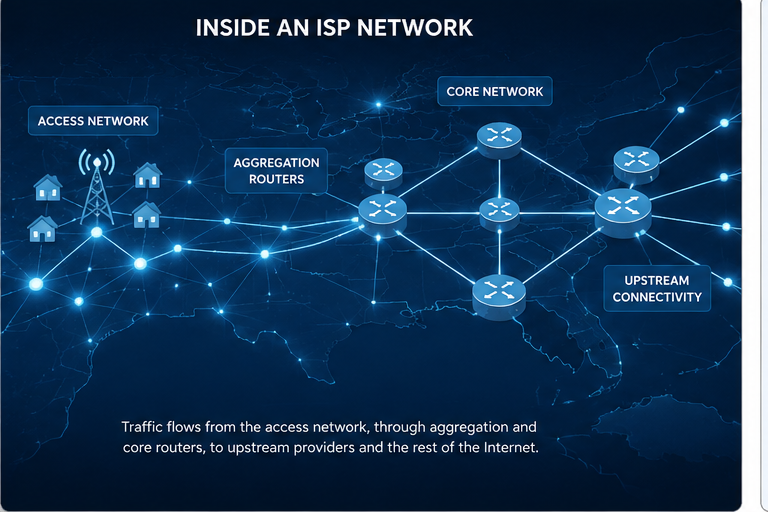
The physical network is only part of the operation. ISPs also maintain systems for billing, DNS, and provisioning. These are all the systems needed to connect customers globally.
Not all ISPs operate at the same scale. A small rural provider may only serve a few counties and buy transit from a regional carrier. A large Tier 1 network may move traffic globally and peer directly with major content providers. The basic mechanics stay similar even though the scale changes dramatically.
The Internet is not a single network. It is literally thousands of independently operated networks interconnected through transport infrastructure. ISPs are the glue holding those networks together. Every time traffic crosses from one ASN to another, providers are coordinating how those packets move across the wider Internet.
j2networks family of siteshttps://j2sw.com
https://startawisp.info
https://indycolo.net
#packetsdownrange #routethelight
Discover more from Justin Wilson (j2sw)
Subscribe to get the latest posts sent to your email.