Walk into almost any data center, central office, or network room and you will see fiber patch cables in multiple colors. Those colors are not just cosmetic. In many cases, the cable jacket color tells an engineer what type of fiber is inside, what wavelength it supports, or whether the cable is intended for single-mode or multimode applications.
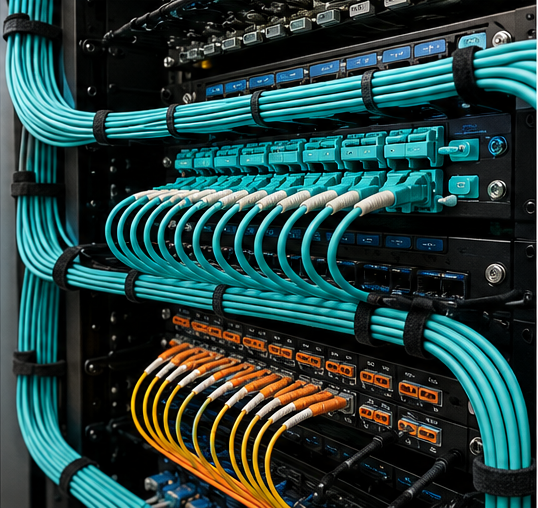
The color itself does not affect how light travels through the fiber. The glass inside the cable does that. The color helps technicians identify the cable quickly without tracing every strand back to the optic or reading labels on both ends.
Fiber Cable Colors Matter
Fiber networks may contain hundreds or even thousands of patch cables in a single cabinet. During a maintenance window, an engineer may need to identify a specific circuit in seconds. A consistent color scheme reduces mistakes and speeds up troubleshooting. With denser AI style racks color codes become essential in identifying cables at a glance.
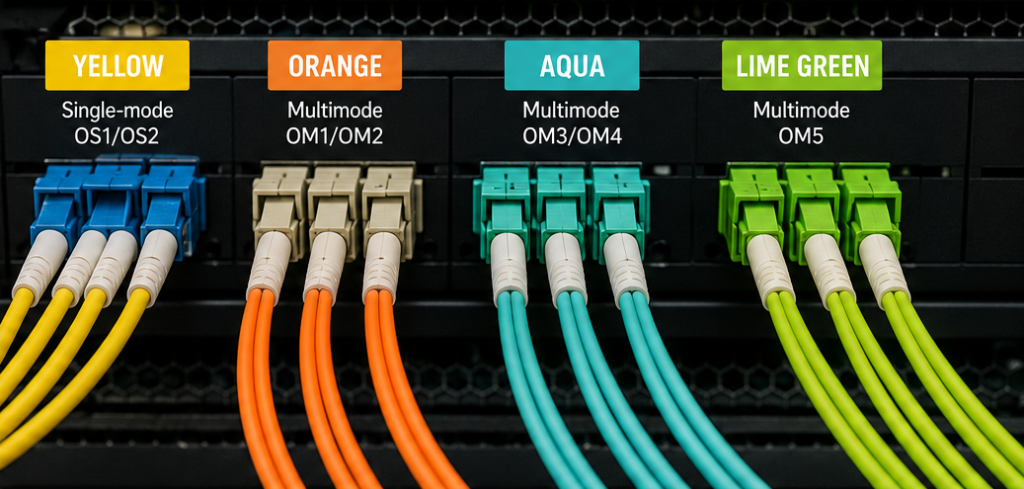
Imagine a rack containing both single-mode Internet circuits and multimode storage connections. If all patch cables were the same color, technicians would spend more time verifying optics and cable types before making changes. The wrong patch cable can prevent a link from coming up or create excessive optical loss.
Yellow Fiber Cables
Yellow is the most common color used for single-mode fiber. Single-mode fiber typically carries light over long distances using a very small core, usually around 9 microns. The optic itself determines the wavelength and speed, but the yellow jacket is often the first clue that the circuit is single-mode. I see single-mode yellow cables most often in Data Centers.
Orange Fiber Cables
Orange is commonly used for OM1 and OM2 multimode fiber. These older multimode standards were popular in enterprise networks and data centers before higher-speed multimode variants became common. Many legacy storage systems and older switch deployments still contain orange fiber jumpers.
OM1 and OM2 have larger cores than single-mode fiber. That larger core allows less expensive optics but limits distance as speeds increase. A 1 Gbps link may run comfortably over older multimode fiber while a modern 100 Gbps circuit often requires newer fiber types.
Aqua Fiber Cables
Aqua is commonly used for OM3 and OM4 multimode fiber. This is one of the most frequently seen colors in modern enterprise data centers. OM3 and OM4 support higher-speed Ethernet applications, including 10G, 40G, and 100G deployments when paired with the proper optics.
A rack full of leaf switches connected to servers may contain dozens of Aqua patch cables. MPO trunks and breakout assemblies are often aqua as well because they are commonly built with OM3 or OM4 fiber.
Lime Green Fiber Cables
Lime green is generally associated with OM5 multimode fiber. OM5 was developed to support short-wave wavelength division multiplexing (SWDM). Multiple wavelengths can travel across the same multimode fiber, increasing capacity without adding additional strands.
OM5 is less common than OM3 or OM4. Many networks continue to deploy OM4 because it is widely available and meets most data center requirements.
Blue Fiber Connectors
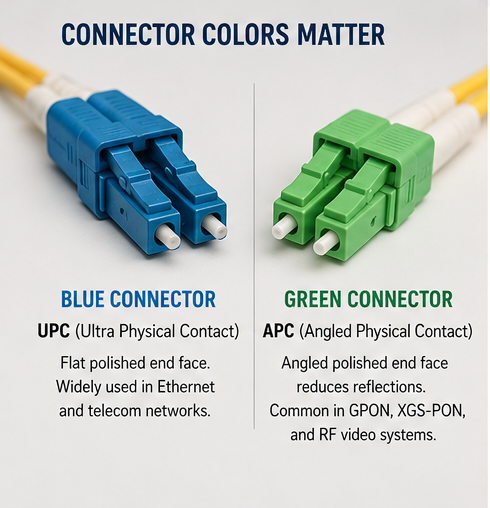
Blue is commonly used for single-mode UPC connectors. The blue color is usually found on the connector body rather than the cable jacket itself. UPC stands for Ultra Physical Contact. These connectors are polished to reduce reflections and are widely used throughout Ethernet and telecommunications networks.
Blue connector bodies are common on routers, switches, transport equipment, and fiber distribution panels.
Green Fiber Connectors
Green connectors typically indicate APC polishing. APC stands for Angled Physical Contact. The fiber end face is polished at an angle that reduces reflected light returning toward the transmitter.
You will often find green APC connectors in GPON, XGS-PON, RF video systems, and other optical networks where reflected light can affect performance. APC and UPC connectors should not be mated together because the different polish angles can damage the connectors and create excessive optical loss.
Fiber Color Standards Are Not Always Followed
The color conventions described above are widely used but not universal. Some manufacturers use custom colors. Some providers order private-label patch cables in company colors. Older installations may contain cables that were installed before current color conventions became common.
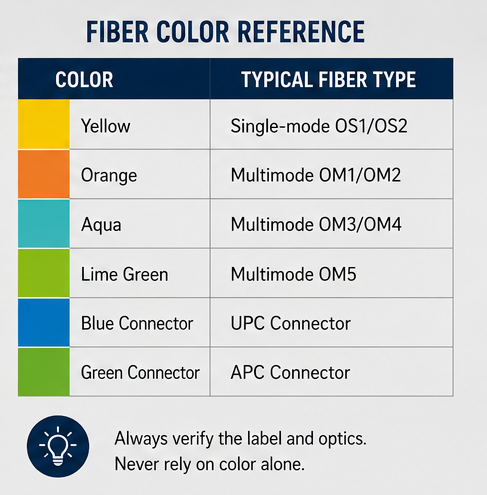
Common Fiber Color Reference
| Color | Typical Fiber Type |
| Yellow | Single-mode OS1/OS2 |
| Orange | Multimode OM1/OM2 |
| Aqua | Multimode OM3/OM4 |
| Lime Green | Multimode OM5 |
| Blue Connector | UPC Connector |
| Green Connector | APC Connector |
What Engineers Usually Look At
Experienced engineers rarely rely on color alone.
The optic part number, connector type, wavelength, transmit power, receive power, and fiber labels tell the full story. Color simply provides a quick visual reference while standing in front of a rack full of patch panels and optics.
j2networks family of siteshttps://j2sw.com
https://startawisp.info
https://indycolo.net
#packetsdownrange #routethelight
Discover more from Justin Wilson (j2sw)
Subscribe to get the latest posts sent to your email.